
Interview Majo Caporaletti

Majo Caporaletti is an Argentinian artist based in Buenos Aires, whose work turns painting into a space for reflection and a way of exploring the boundaries between matter and spirit. Her latest works transform the impressions of a journey through the Atacama Desert into intimate, internal landscapes.
These paintings transform desert impressions into a space for memory and sensation, encouraging an experience that goes beyond the visual. Animals often appear in her work as symbolic guides, bridging the visible and the invisible, while landscapes carry memory and energy, acting as living entities within the compositions.
The familiar meets the mysterious as opposing forces collide on the canvas, creating eruptions of matter and poetic reconstructions of form. Engaging with the rhythms of nature, her work reflects cycles of dissolution, regeneration, and transformation, capturing light as expansive as water and as intimate as the glimmer behind a gaze. Ritualistic gestures and metaphoric elements quietly infuse the scenes, suggesting processes of spiritual transformation and reconnection.
Echoing her ongoing spiritual and artistic inquiries, these landscapes act as mirrors of transformation, where the Atacama becomes a shifting space onto which new possibilities can be projected.

Interview (English)
You have said that painting functions for you as a refuge and as a form of understanding. What kind of understanding does painting allow that does not appear in other languages?
For me, understanding is a way of being in the world — an attitude. From a very young age, I have approached the world in a more intuitive and empirical way than a rational one. When learning other languages, for example, I first needed to immerse myself in listening and in the musicality of the language, and only afterwards study its grammar. Something similar happens for me with visual language.
Approaching colour can initially seem like a technical task, but truly understanding colour is far more complex. In painting, it is not enough to understand the thing in itself; what needs to be understood is the web of relationships between elements. These relationships cannot be schematised or fixed, because everything is constantly shifting. What one learns through this intuitive process gives me tools to develop a deeper understanding of how to inhabit the world.
Painting is a state of availability — of allowing oneself to be affected by what surrounds you. Painting is, for me, a form of translation. I paint in order to digest what gets stuck, what wounds from within; to give form to what has no form, to what I cannot name. Sometimes painting allows me to understand personal and emotional processes; at other times, it allows me simply to move through emotions without assigning them meaning.
At what point does an experience stop being lived and begin to transform into painting?
It depends. Experience creates a groove; it leaves traces — of light, matter, substance, colour, sensation. Over time, these traces germinate into ideas, but the temporal distance is variable. Sometimes the translation from experience into painting is immediate, because it was highly visual or sensory; at other times it is slower and largely unconscious.
When you work, do you start from an image, from a bodily sensation, or from something more difficult to name?
Where a painting begins is always a mystery. Sometimes the image emerges from a visual experience: a journey in nature, a walk through the city, a painting seen in a museum or in a book, a still from a film. That moment of discovery — of truly seeing something — is precious, and it remains somewhere in memory.
At other times the starting point is more narrative: a phrase that comes to mind, something that helps me articulate an emotional state or sensation, or something I read. In general, I do not choose how a painting begins; it is something that happens, beyond my control.

You mention that photography fulfilled an archival function (during my trip to Atacama). What did painting allow you to do that photography did not during that journey?
During my trip to Atacama, photography helped me capture moments of light, forms, landscapes and figures that I later wanted to paint. It functioned as a reference tool. Painting, by contrast, allows me to remain within the image — to inhabit it as a form of thought. Producing a painting takes many hours, sometimes over the course of a month. It involves an accumulation of time and brushstrokes to reconstruct a fleeting memory and preserve the sensation it left behind.
Which aspects of the experience are reactivated through painting and not through photographic recording?
Painting allows me to access a more tactile kind of memory — recalling contact with a surface, a ground, a stone, a mountain; understanding an object through its materiality. Even when many of the things I paint do not exist as such, I still need to grasp something of the material presence that emerges. I am interested in the substance of things being felt.
Through painting, I also enter another temporality, and I gain the freedom to establish my own parameters of light, colour and form.
Is the memory that appears in your works a faithful reconstruction, a transformation, or something entirely new?
Elements of reality appear frequently in my work — or elements that can be recognised as such: landscapes, animals, human figures, fragments of nature. I am interested in combining these with images drawn from dreams or imagination, creating an atmosphere of strangeness, whether through colour or through unexpected juxtapositions.
In my more recent paintings, this process intensifies and extends beyond the boundaries of the real. I want the image to be porous — a territory one can enter because it feels familiar, but which gradually shifts towards the unfamiliar, sometimes becoming almost unrecognisable.
I think of reality as a very thin membrane, and I am interested in working on the fissures through which strangeness seeps in — that unsettling quality that disturbs what is known.
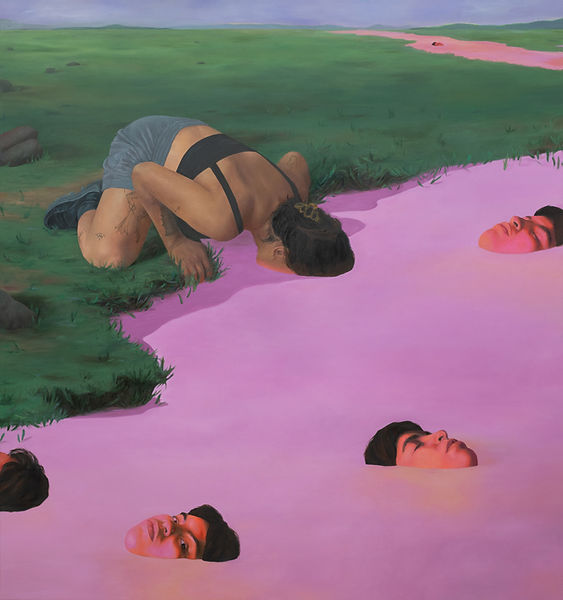
In what way does the body become involved in these landscapes you call “internal”?
The bodies in the Internal Landscapes series evoke introspective emotional states. Figures — human or animal — often appear with their eyes closed or with a gaze directed inward, in a contemplative state that suggests a suspended or static temporality.
These are more passive images. Nature does not function as a descriptive environment, but rather as a metaphor for psychic and emotional processes. The landscape becomes a projection of the body’s inner state, where exterior and interior fold into one another.
The desert is often associated with the idea of emptiness. What did you find there that contradicts that perception?
In the Atacama Desert, I encountered a landscape that felt both deeply strange and profoundly familiar. Even before knowing I would travel there, I had painted scenes that seemed to originate from that place: cavities in the earth, smoke rising from water. These images helped me give form to anguish and emptiness — emotional states I often explored.
Yet when I arrived in Atacama, I felt no emptiness at all. Landscape is everywhere; it is infinite, seemingly endless. It is full of nothingness, but also of history, memory and energy. And nothingness is not emptiness. There is an intense presence — of the sun, the surrounding volcanoes, the mountains, the wind, the stars.
The desert is also in constant transformation. The light is cooler in the morning and warmer in the afternoon; the wind reshapes the dunes. Added to this is an extraordinary diversity of terrain: valleys, dunes, salt flats, lagoons, geysers.
Spending many days in such an expansive territory, constantly facing the horizon, begins to alter one’s way of thinking and perceiving. My thoughts became clearer; my gaze more extended. I reflected on how, in cities, vision becomes flattened — we do not see the horizon, we live surrounded by screens — and how this directly affects perception and creativity.
(I once joked with a friend who lives in the countryside that I cope better than most city dwellers because I am constantly inventing pictorial worlds as a form of escape.)
I spent a month in Atacama at the Wayaka Current residency. It was a profoundly inward journey. I was deeply focused on my practice, and it helped me reconnect with what truly matters — the deeper meaning of why one does what one does.

Do you feel that the journey and the subsequent work changed your way of perceiving landscape?
In fact, it began a few months earlier. In June 2024, I took part in an exhibition in New York at Galería Praxis, and while visiting museums there, I fell in love with the landscapes of the Hudson River School — Cole, Church and Bierstadt — as well as with those of Georgia O’Keeffe.
When I returned to Buenos Aires, it was winter, and I had spent two years painting nocturnal scenes with dark backgrounds and shadows. I remember covering one of those dark grounds and painting over it with a very pale blue mixed with soft oranges. Without intending to, some of the desert light of O’Keeffe entered my work.
Some months later, unexpectedly, I was selected for the residency in Atacama.
Is the transformation that appears in the work something you consciously seek, or something that emerges during the process?
I begin a painting without many certainties. I do not work from preparatory sketches, although I do take photographic records of people and landscapes I wish to represent. From these images, I make an initial scribble — less a drawing than a way of understanding relationships and tensions — and then I move directly into painting.
I begin by drawing with the brush, searching for the main forces and directions within the composition. Painting becomes a space of testing and dialogue. At times the process flows; at others it resists. It oscillates between pleasure and discomfort, sustained through persistence.
Many fundamental decisions are made as the work unfolds. Even at very advanced stages, I often introduce significant changes.
You speak of a light that is not only visible, but also emotional or interior. How do you paint something that cannot be directly observed?
It is a beautiful question. Not being able to observe something directly does not mean that it cannot be seen. It relates to that state of availability I mentioned earlier. Philip Guston once said, I paint what I want to see. It is about giving form, through painting, to an internal necessity.
What place does mystery occupy within your artistic practice?
I have always been deeply drawn to the Baroque, particularly for the tension it creates between light and shadow, between revelation and concealment. That tension generates an atmosphere that feels suspended, almost palpable. This dimension is very present in my work.
Over time, I have realised that mystery in my paintings does not reside only in shadow or in what remains hidden, but also in a way of relating to reality in which something is left open — the fissure I mentioned earlier. I am interested in images that do not offer closed answers, that remain unresolved, that invite uncertainty, where more is sensed than fully understood.
Interview (English)
Transcript: Adela Blanco
Text: Adela Blanco
Photos: Courtesy of the artist, Majo Caporaletti
.jpg)


.jpg)
Entrevista (Español)
Majo Caporaletti es una artista argentina radicada en Buenos Aires. Su trabajo convierte la pintura en un espacio de reflexión y en una forma de explorar los límites entre la materia y el espíritu. Sus obras más recientes transforman las impresiones de un viaje por el desierto de Atacama en paisajes íntimos e interiores.
Estas pinturas trasladan las impresiones del desierto a un territorio de memoria y sensación, invitando a una experiencia que va más allá de lo visual. Los animales aparecen con frecuencia como guías simbólicas, tendiendo puentes entre lo visible y lo invisible, mientras que los paisajes cargan memoria y energía, actuando como entidades vivas dentro de las composiciones.
Lo familiar y lo enigmático se encuentran cuando fuerzas opuestas colisionan en la superficie pictórica, dando lugar a irrupciones de materia y a reconstrucciones poéticas de la forma. En diálogo con los ritmos de la naturaleza, su obra refleja ciclos de disolución, regeneración y transformación, y captura una luz tan expansiva como el agua y tan íntima como el destello que se insinúa detrás de una mirada. Gestos rituales y elementos metafóricos atraviesan silenciosamente las escenas, sugiriendo procesos de transformación espiritual y reconexión.
En sintonía con sus búsquedas artísticas y espirituales, estos paisajes funcionan como espejos de transformación, donde el Atacama se convierte en un espacio mutable sobre el cual se proyectan nuevas posibilidades.
Has dicho que la pintura funciona para ti como un refugio y como una forma de comprensión. ¿Qué tipo de comprensión te permite la pintura que no aparece en otros lenguajes?
Para mí comprender es una forma de estar en las cosas, una actitud. Desde pequeña me acerqué al mundo de una manera más intuitiva y empírica que racional. Para aprender a hablar otros idiomas, por ejemplo, primero necesité sumergirme en la escucha y en la musicalidad de esa lengua, y después estudiar su gramática. Algo similar me sucede con el lenguaje visual.
Acercarse a un color, en principio, puede ser una tarea muy técnica, pero comprender realmente un color es mucho más complejo. En una pintura no alcanza con entender la cosa en sí misma: lo que hay que comprender es el conjunto de esas relaciones. No funciona esquematizarlas y estructurarlas, porque todo se mueve constantemente. Lo que una aprende en este proceso, que requiere mucha intuición, me da herramientas para tener cierta comprensión de cómo estar en el mundo.
Pintar es estar en estado de disponibilidad, dejarse afectar por las cosas que te rodean. La pintura es para mí una traducción. Pinto para digerir lo que se atraganta, lo que lacera desde adentro, para hacer visible lo que no tiene forma, lo que no puedo nombrar. A veces la pintura me sirve para comprender procesos personales y emocionales; otras, para transitar emociones sin darles un significado.
¿En qué momento una experiencia deja de ser vivida y comienza a transformarse en pintura?
Depende. La experiencia crea un surco, va dejando impresiones o huellas: de luz, de materia, de sustancia, de color, de sensaciones. Con el tiempo, todo eso germina en ideas, pero la temporalidad es variable. A veces la traducción de una experiencia en pintura es inmediata, porque fue algo muy visual o sensorial; y otras veces es mucho más lenta e inconsciente.
Cuando trabajas, ¿partes de una imagen, de una sensación corporal o de algo más difícil de nombrar?
Dónde empieza una pintura siempre es un misterio. A veces la imagen surge de una experiencia visual, que puede venir de un viaje en la naturaleza, de una caminata por la calle, de una pintura que vi en un museo o en la reproducción de un libro, o de un fotograma de una película. Ese momento de descubrir algo, de verlo, es precioso y queda en algún lugar de la memoria.
Otra forma es más narrativa: a partir de una frase que me viene a la cabeza, o algo que me sirve para describir un estado emocional o una sensación, o algo que leo en un libro. En general no elijo cómo empezar: es algo que sucede y que no puedo controlar.
Mencionas que la fotografía cumplió una función de archivo (en mi viaje a Atacama). ¿Qué te permite la pintura que no te permitió la fotografía durante ese viaje?
En mi viaje a Atacama, en particular, la fotografía me ayudó a captar momentos de luz, formas, paisajes o figuras que quiero pintar. Es una herramienta que utilicé como referencia. La pintura, en cambio, me permite permanecer en la imagen, habitarla como una forma de pensamiento. Realizar una pintura me lleva muchas horas, a veces no menos de un mes. Es mucho el tiempo que paso en esas imágenes: una acumulación de horas y pinceladas para reconstruir un recuerdo fugaz y preservar la sensación que dejó.
¿Qué aspectos de la experiencia se reactivan a través de la pintura y no a través del registro fotográfico?
La pintura me permite acceder a otra temporalidad, a un tipo de memoria y de sensación más táctil: recordar el contacto con una superficie, un suelo, una piedra o una montaña, entender el objeto a través de su materia. Si bien muchas cosas que pinto no existen, igual necesito poder comprender algo de esa materialidad que aparece. Me interesa que se perciba la sustancia de las cosas.
¿La memoria que aparece en tus obras es una reconstrucción fiel, una transformación o algo completamente nuevo?
En mi pintura aparecen con frecuencia elementos de la realidad, o que se pueden reconocer como tales: elementos de la naturaleza, animales, paisajes, figuras humanas. Me interesa luego mezclarlos con imágenes provenientes de los sueños o de la imaginación y generar un clima de extrañamiento o de rareza, ya sea a través del uso del color o de la combinación de esos elementos.
En mis obras más recientes este proceso se intensifica y comienza a abrirse más allá de los bordes de lo real. Busco que la imagen sea porosa: un territorio al que se pueda entrar porque resulta familiar, pero que lentamente se vaya desplazando hacia lo extraño, hasta volverse, en algunos casos, incluso irreconocible.
Pienso la realidad como una membrana muy fina y me interesa trabajar sobre las fisuras por las que puede filtrarse esa extrañeza, eso inquietante que altera lo conocido.
¿De qué manera el cuerpo queda involucrado en estos paisajes que llamas “internos”?
Los cuerpos de la serie Paisajes internos evocan estados emocionales introspectivos. Las figuras representadas —o los animales— generalmente están con los ojos cerrados o con una mirada que va más hacia adentro, en un estado contemplativo que refleja una temporalidad estática o detenida.
Son imágenes más pasivas, y la naturaleza no opera como un entorno descriptivo, sino como una metáfora de procesos psíquicos y emocionales. El paisaje funciona como una proyección del estado interno del cuerpo, donde lo exterior y lo interior se pliegan.
El desierto suele asociarse con la idea de vacío. ¿Qué encontraste allí que contradice esa percepción?
En el desierto de Atacama me encontré con un paisaje muy extraño y, al mismo tiempo, profundamente familiar. Incluso antes de saber que iba a viajar allí, ya había pintado escenas que parecían venir de ese lugar: huecos en la tierra, humo saliendo del agua. Eran imágenes que me ayudaban a darle forma a la angustia y al vacío, estados emocionales que solía representar a menudo.
Sin embargo, cuando llegué a Atacama no sentí vacío en absoluto. Hay paisaje por todos lados: es infinito, no se termina nunca. Está lleno de nada, pero también de historia, de memoria, de energía. Y la nada no es vacío. Hay una presencia muy fuerte de todo: del sol, de los volcanes que te rodean, de las montañas, del viento, de las estrellas.
Además, el desierto cambia constantemente. La luz es más fría por la mañana y más cálida por la tarde; el viento mueve la arena y cambia la forma de los médanos. A eso se suma la enorme diversidad del paisaje: valles, dunas, salares, lagunas, géiseres.
Cuando pasás muchos días en un territorio tan extenso, mirando el horizonte de manera constante, ese paisaje despejado empieza a entrar en tu forma de pensar y de percibir. Fueron días en los que los pensamientos se aclararon mucho y la mirada estaba más elongada. Estando allí pensaba en cómo, en las ciudades, la mirada se achata: no vemos el horizonte, vivimos rodeados de pantallas, y eso influye directamente en nuestra creatividad y en nuestra percepción.
(Un amigo que vive en el campo me dijo que, de sus amigas que viven en la ciudad, soy la que mejor lo lleva, y concluimos que era porque estoy constantemente inventando estos mundos pictóricos en los cuales muchas veces me evado.)
Estuve un mes en Atacama, en la residencia de Wayaka Current. Fue un viaje muy interior. Estaba profundamente enfocada en la práctica y me sirvió para volver a poner el foco en lo importante, en el sentido más profundo de por qué una hace lo que hace.
¿Sientes que el viaje y el trabajo posterior cambiaron tu forma de percibir el paisaje?
En realidad, comienza unos meses antes. En junio de 2024 participé de una muestra en New York, en Galería Praxis, y fue allí que, visitando los museos, quedé enamorada de los paisajes de la escuela del río Hudson (Cole, Church, Bierstadt) y de los de Georgia O’Keeffe.
Cuando volví a Buenos Aires era invierno y hacía dos años que estaba pintando la noche como tema, con sombras y fondos muy oscuros. Recuerdo que tapé un fondo oscuro que tenía y le puse un celeste muy clarito, mezclado con unos naranjas. Sin darme cuenta y sin buscarlo, algo de la luz del desierto de O’Keeffe había entrado en mi pintura.
Y, medio inesperadamente, unos meses después quedé seleccionada para la residencia en Atacama.
¿La transformación que aparece en la obra es algo que buscas de manera consciente o algo que surge durante el proceso?
Desde el inicio del proceso no parto de muchas certezas al comenzar una pintura. No trabajo a partir de bocetos previos, aunque sí realizo registros fotográficos de las personas y los paisajes que deseo representar. A partir de esas imágenes hago un primer garabato, más como una herramienta para comprender relaciones y tensiones que como un dibujo en sí mismo, y luego comienzo directamente a pintar.
Empiezo la pintura dibujando con el pincel, buscando las fuerzas y las direcciones principales de la composición. La pintura se convierte entonces en un campo de prueba y de diálogo. Hay momentos en los que el proceso fluye y otros en los que se vuelve más resistente; es una experiencia que alterna entre lo placentero y lo incómodo, pero que se sostiene en la insistencia.
Gran parte de las decisiones fundamentales se toman a medida que la obra avanza. Incluso en etapas muy avanzadas del proceso suelo introducir cambios significativos.
Hablas de una luz que no es solo visible, sino también emocional o interior. ¿Cómo se pinta algo que no puede observarse directamente?
Es hermosa esta pregunta. Que no lo puedas observar directamente no significa que no lo puedas ver; tiene que ver con ese estado de disponibilidad del que hablaba al comienzo. Philip Guston tiene una frase que dice I paint what I want to see. Es la idea de poder dar forma, a través de la pintura, a una necesidad interna.
¿Qué lugar ocupa el misterio dentro de tu práctica artística?
Siempre me interesó profundamente el barroco como corriente artística, en particular por la tensión que establece entre la luz y la sombra, entre aquello que revela y aquello que oculta. Esa tensión genera un clima, una atmósfera que parece quedar suspendida en el aire. En mi pintura, esta dimensión está muy presente.
Con el tiempo fui descubriendo que ese misterio, en mis obras, no aparece únicamente en la sombra o en lo que permanece oculto, sino también en un modo de relación con lo real en el que algo queda abierto, la fisura que nombraba antes. Me interesan las imágenes que no ofrecen respuestas cerradas, que me dejan en la pregunta, que son ambiguas y me invitan a habitar la incertidumbre, donde se intuye más de lo que se comprende.
Entrevista (Español)
Transcripción: Adela Blanco
Texto: Adela Blanco
Fotos: Cortesía de la artista, Majo Caporaletti
.jpeg)